Beuford Smith: Seeing From Within
- Arnold Plotnick

- Apr 14
- 6 min read

Every now and then, you walk into a gallery and realize you’ve just met a photographer you should have known all along. That was my experience with Beuford Smith.
A fellow member of my photography meetup group (The Art of Photography – NYC) recommended the exhibit, which was going to close in a few days. I went into this very small gallery expecting to spend a half hour or so. I lingered much longer. Two videos were playing back-to-back on a monitor in the corner, and they alone were about 30 minutes, and completely absorbing. The room was quiet, I had it completely to myself, and the photographs—39 black-and-white prints spanning decades—cast a spell on me.

By the time I left, I had that familiar feeling: part admiration, part curiosity, part envy, and a big dose of “how did I miss this guy?” (Which is always a slightly humbling realization at this stage of the game.)
Smith was one of those photographers who seemed to live with a camera as an extension of himself. Photography was his language, and he spoke it fluently, moving easily between street photography, documentary work, abstraction, and portraiture. And he didn’t just make photographs. He was, by all accounts, a generous man, building things in the photography world that led to opportunities for others.
I’m perfectly happy being a fan of a photographer based solely on their work. But it adds another dimension when you find out the person behind the camera was also a genuinely good human being. For me, that matters. (Thankfully, the video that I saw at the gallery is available on YouTube, so if you want to see what a kind, smart, talented man Beuford Smith was, see for yourself)
Smith’s work came out of a time and place where access to the mainstream photographic world was limited for Black photographers. Smith was a key member (and later president) of the Kamoinge Workshop, the name is derived from the Kikuyu word for “a group of people acting together”. Founded in the early 60’s, it was a collective that shared political and artistic space for self-determination among a group of Black American photographers who were living and working in New York City. They gathered weekly to exchange, review, critique each other’s work, and generally support each other as they developed their own visual language and style outside the usual gatekeepers.
I had never heard of Kamoinge. And then, three days later, I’m at the Museum of the City of New York, checking out a Robert Rauschenberg photography exhibit (taking full advantage of everything this city has to offer), and—lo and behold—in the gift shop is a book called Timeless: Photographs by Kamoinge, a large, heavy coffee-table-book featuring works by 30 members of the collective. (I’m choosing to believe the universe occasionally curates my gallery visits.) I stood there flipping through it, enjoying more of Smith’s work, including a number of photos that he discusses in the video I referenced above. (That book is now sitting very comfortably at the top of my wish list.)


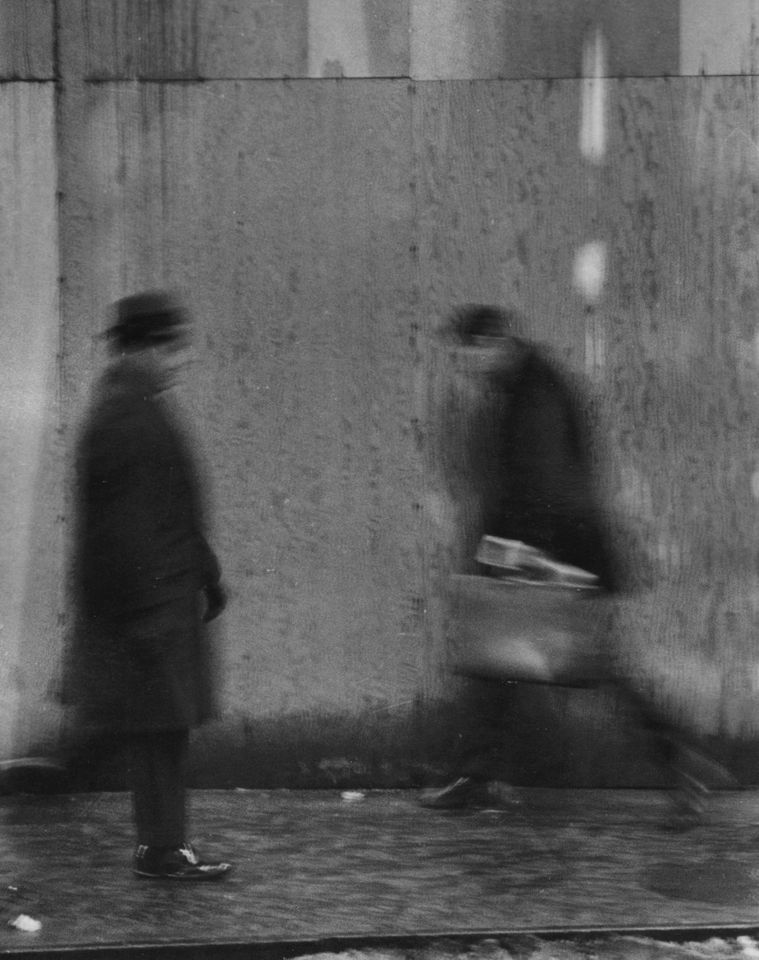


There’s a confidence in his photographs, a sense that the photographer belongs exactly where he is, and nowhere is that more evident than in the images he made on April 5, 1968, the day after Dr. Martin Luther King Jr. was assassinated. Smith walked through Harlem with his camera, documenting a community processing grief in real time. These aren’t distant, journalistic images. They feel immediate, personal, and deeply human. Several of these were on the wall of the gallery, and trust me, these aren’t images you scroll past. They slow you down whether you want them to or not.

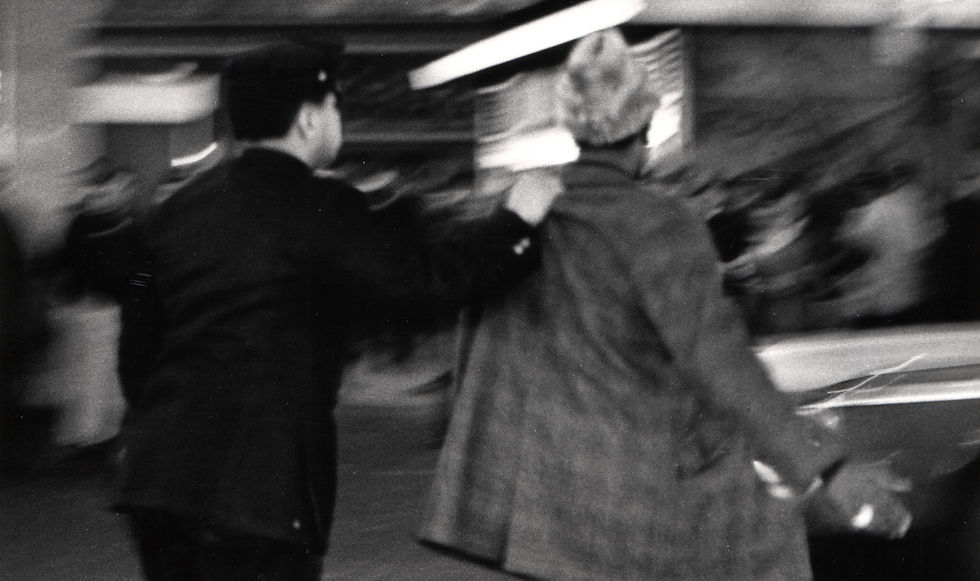


One photograph in particular, of a young Black man in Harlem, his eyes streaming with tears as he witnesses a white delivery man being beaten on 125th Street, embeds itself in your mind and stays there. It’s not just about what happened. It’s about how it felt. Big difference. A lot of photography shows you events. Smith shows you experience. And once you see it that way, it’s hard to go back.

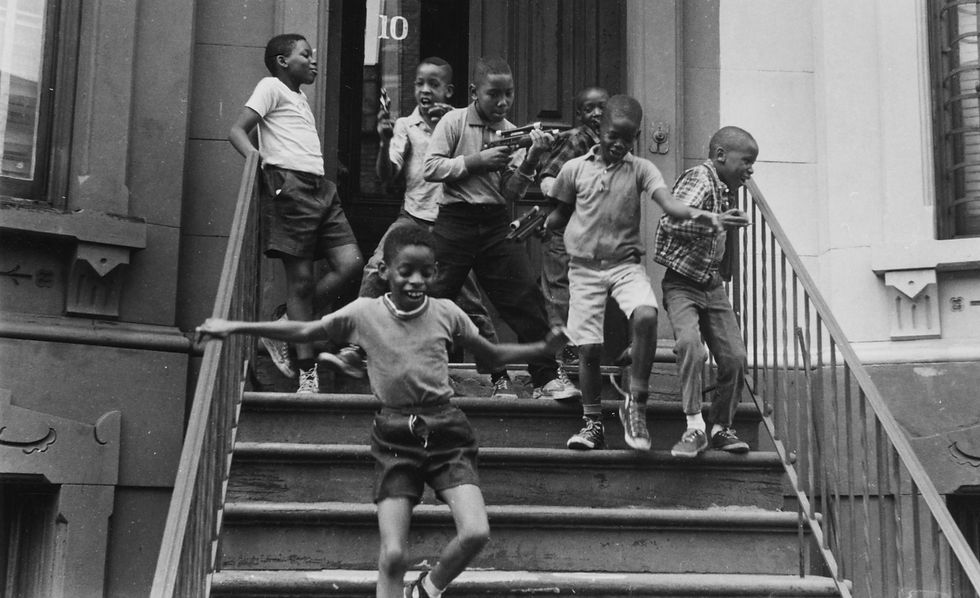
Although those images were clustered together on the gallery wall (see above), the exhibition wisely didn’t isolate them as “the important ones.” They sat alongside scenes of everyday life: kids on the street, couples, musicians, quiet moments that might otherwise go unnoticed. It’s the kind of street photography that attracts me the most, the kind I aspire to. Hard to believe that Smith’s same eye is at work in all of them. He moves seamlessly between the historic and the ordinary without changing tone or intent. That consistency is striking.


Stylistically, you can see echoes of photographers we all know—Robert Frank, Helen Levitt—but Smith has his own thing going. He plays with shadow and silhouette, makes the most of motion blur, and occasionally leans into abstraction. This go-with-the-flow style almost feels jazz-like (and here I’m using that word deliberately as a nod to his terrific photos of jazz musicians, some of which you can see and hear about in that video.) I’ll let photographer Ming Smith extend the jazz analogy further:
“As Miles Davis was to jazz, Beuford was to photography. He was part of the black community, very generous in his spirit. He took responsibility for his images and with those images he portrayed the best in our culture. I felt the tenderness, the humanity, the community, the love that he had with the community through his images. He was hip, and by that, I mean very sophisticated, very intellectual, just like Miles was. He had bop, he was like bebop.”

Beyond the photographs themselves, Smith’s legacy is also tied to what he helped build. In 1973, he co-founded The Black Photographers Annual, a publication that gave Black photographers a platform at a time when mainstream outlets largely ignored their work. The four issues (1973, 1974, 1976, and 1980) worked to counter the prevailing representations of Black life that was propagated by mainstream arts institutions and publications. Writers like Toni Morrison and James Baldwin contributed, and for many photographers, it was the first time they saw their world represented with that kind of clarity and seriousness. For younger artists, it was a revelation. Photographer Jeanne Moutoussamy-Ashe recalls, “As a young student seeking to begin my studies at the school (Cooper Union in NYC), seeing and meeting Beuford was formidable and my artistic community expanded immediately, in the best possible way.” Photographer Russel Frederick remarked on his encouragement. “He believed in me from day one. So many of us want to be great but do not have a guidance counselor. Beuford believed in me, trusted me, and opened his doors and resources to me. He blazed a trail through some tumultuous times. He walked good.” This is the kind of legacy one dreams of achieving. Smith accomplished that dream.


Smith passed away in June 2025 at the age of 89, a profound loss to the photography world. His work now lives in major museum collections—the Museum of Modern Art, the Whitney, and others—but there’s something about seeing it in a smaller gallery setting that feels right. More intimate. More aligned with the spirit of the work. I’m grateful I got to experience this small exhibit before it closed. One of Smith’s peers, Adger Cowans, said of Smith’s work, “His photographs cannot be understood at first glance.”
I hope to gain a better understanding of his work in the future, because I plan on taking many more glances.




Comments