Gonzo: A Graphic Biography of Hunter S. Thompson, by Will Bingley and Anthony Hope-Smith
- Arnold Plotnick

- May 5
- 3 min read
A quick, entertaining read that falls a little short of its goal.

“We were somewhere around Barstow, on the edge of the desert, when the drugs began to take hold.”
When people list the most famous opening lines in literature, they usually mention “Call me Ishmael” or “It was the best of times, it was the worst of times.” For me, Hunter S. Thompson’s immortal opening to Fear and Loathing in Las Vegas belongs right alongside them.
Like most college kids in the late 1970s and early ’80s, I was enthralled with Hunter S. Thompson. Many of my friends were drawn mainly to the gonzo mythology—the drugs, the rage, the chaos. That aspect certainly had its appeal, but what hooked me first was Hell’s Angels, followed by Fear and Loathing on the Campaign Trail ’72. I subscribed to Rolling Stone for years and devoured Thompson’s columns. When my friends and I finally got hold of Fear and Loathing in Las Vegas, the book circulated endlessly through our circle—spilled on, battered, and barely holding together—before somehow finding its way back to my shelf, where it still sits decades later.

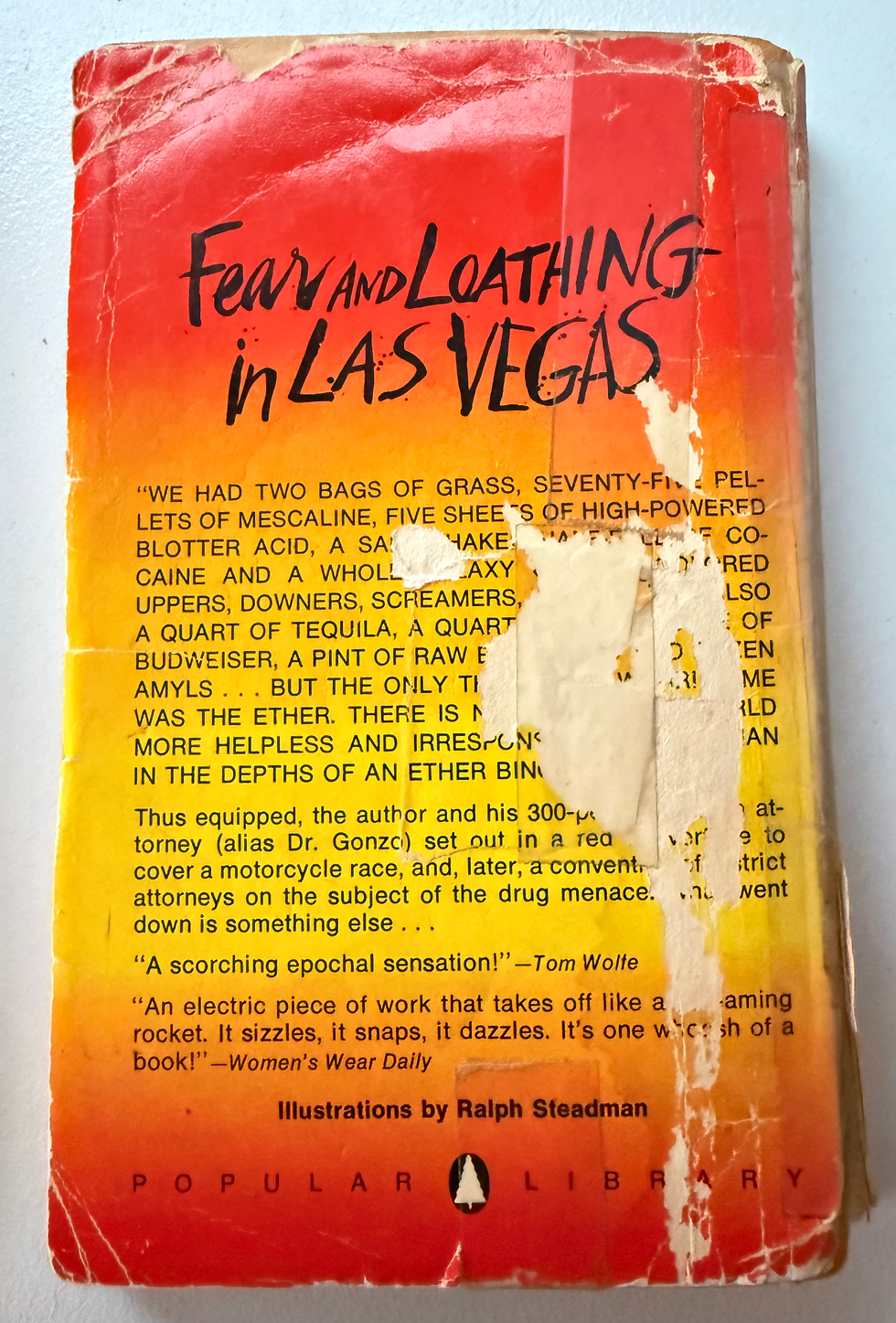
(My actual copy of the book, still decrepit, but readable.)
But time has a way of changing perspective. The wildness that once seemed rebellious and hilarious now feels darker: the guns, the addiction, the destructive anger, and the sense of enormous talent squandered. The films Where the Buffalo Roam and Fear and Loathing in Las Vegas only amplified the Raoul Duke caricature, further blurring the line between the writer and the legend.
Which brings me to Gonzo, a graphic biography of Thompson that I found unexpectedly in the laundry room of my apartment building, where neighbors occasionally leave books for others to take. The foreword by Thompson’s editor Alan Rinzler promises something intriguing: a portrait that looks beyond the gonzo myth to the disciplined, fiercely committed journalist who cared deeply about every word he wrote.
The graphic-novel format turns out to be a clever fit. Thompson’s life already feels almost cartoonish—perpetually on the move, bouncing between jobs, chasing stories, clashing with authority. The book focuses largely on the explosive decades of the 1960s and ’70s, when Thompson produced his most important work: Hell’s Angels, Fear and Loathing in Las Vegas, and his remarkable political reporting during the 1972 presidential campaign. The turbulent backdrop of the era—Vietnam, the Kennedy assassination, the counterculture—runs parallel to Thompson’s rise as a singular voice in American journalism.
The visual storytelling occasionally works quite well. The art captures the restless energy and underlying darkness of Thompson’s life, contrasting moments of manic momentum with quieter scenes of reflection. One particularly striking motif shows Thompson either racing toward something, or slumped in weary contemplation, as though aware that the whirlwind he helped create was eventually going to consume him.
Still, the book only partially succeeds at its central goal. It tries to rescue Thompson from the cartoonish “King of Gonzo” persona and remind readers that he was a serious journalist with genuine moral and political commitments. Yet even here, the myth often overwhelms the man. The later decades of Thompson’s life are rushed through quickly, leaving mostly the familiar image of a brilliant writer trapped inside the larger-than-life character he created.
In the end, Gonzo reminds us that behind the chaos, the drugs, and the mythology was a remarkable journalist. The trouble is that even now, decades later, the legend of Hunter S. Thompson still tends to drown out the writer.


Comments