The Streets My Father Knew
- Arnold Plotnick

- Mar 13
- 3 min read
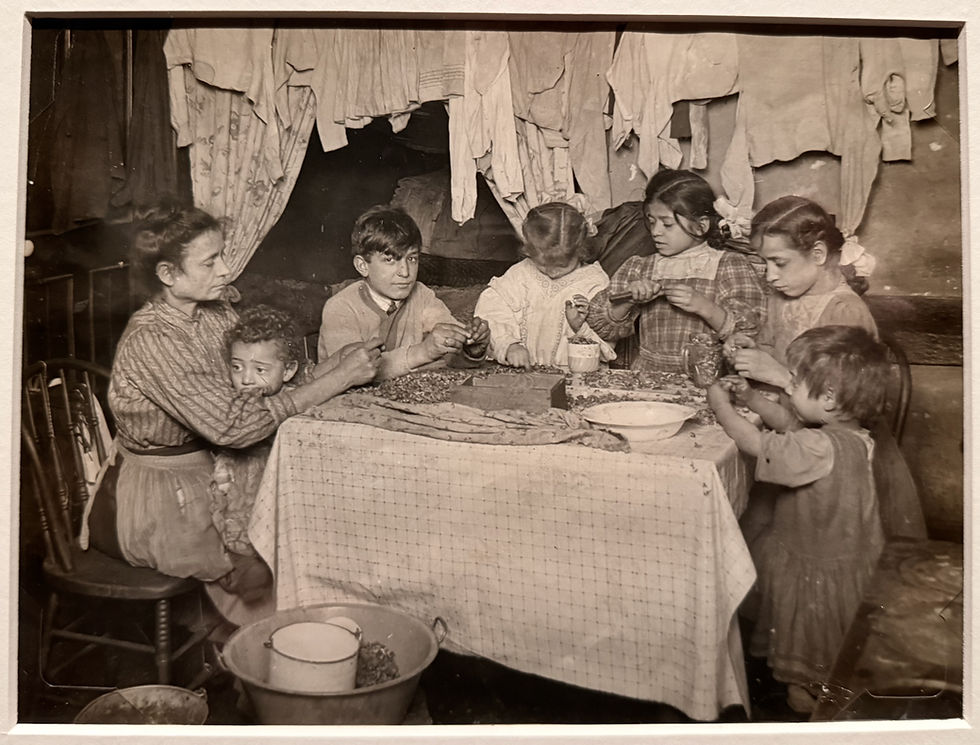
A couple of weeks ago I visited the New York Historical to see an exhibit titled Stirring the Melting Pot, a collection of photographs documenting the immigrant experience in New York City. The images immediately resonated with me in several different ways.

First, as a street photographer. Many of these images were made as documentary photographs or photojournalism, but they are also beautifully composed pictures. The photographers were capturing everyday life—people working, sleeping, studying, cooking, gathering on stoops—but doing so with a strong visual eye.

Second, they resonated with me as a New Yorker. The photographs show the city in its earlier days: storefronts, crowded sidewalks, tenement interiors, and the dense street life that defined neighborhoods like the Lower East Side.
But most of all, the exhibit resonated with me as the child of immigrants.
My father’s story is a classic New York immigrant story. His large family came from Russia around 1910, arriving through Ellis Island and settling on the Lower East Side. The family name was changed, they squeezed into tenement housing, and the garment sector played a large role in their lives, just like thousands of other immigrants trying to build a life in a new country.

I grew up in Brooklyn and spent much of my adult life living in different parts of Manhattan. But about two years ago I moved to the Lower East Side myself, and it felt like a strange kind of homecoming. My father once lived on Forsyth Street. That particular block has since been demolished, but the surrounding streets and tenement buildings remain. Walking those streets now, it’s hard not to imagine my father and his siblings running around those same sidewalks more than a century ago.

He rarely talked about tenement life (probably because it wasn’t something he wanted to relive), but visiting the Lower East Side Tenement Museum a few years ago gave me a vivid sense of what daily life must have been like for him and his family: cramped apartments, shared spaces, and entire families living in rooms barely large enough to hold a bed and a stove.

By the early twentieth century, nearly two-thirds of New York City residents lived in tenements. The conditions were often crowded and unsanitary, but these neighborhoods also became places where immigrants built community. Streets and stoops became extensions of the home.
The stoop, in particular, was a defining part of neighborhood life. The word itself comes from the Dutch stoep, meaning a raised platform. Originally built to keep buildings above floodwaters and street grime, stoops eventually became social spaces—places where neighbors gathered, kids played, and daily life unfolded in full view of the street.

When I was a kid, stoops were still a big part of neighborhood life. We even had a game called stoopball. You’d throw a pink Spaldeen against the stoop and catch the rebound. One bounce before the catch was five points. Catching it clean off the stoop without a bounce was ten. If it hit the corner of the step (you could tell by the high arc as it left the step) and you caught it, that was a hundred points. First one to amass 1,000 points was the winner.

Looking at these photographs, you can see the foundations of the city we still recognize today: the crowded streets, the improvised neighborhoods, the constant mixing of cultures. New York has often been described as a melting pot, but walking through this exhibit it felt more like a patchwork quilt composed of countless individual stories layered together to create something uniquely New York.
One photograph in the exhibit showed immigrant children sitting in a classroom, learning the language and skills that would help them find their place in their new country.

Seeing that image immediately brought to mind a photograph from my own family that has somehow survived for nearly a century.
It’s a classroom photograph taken sometime in the mid-1920s. If you look closely, on the right side of the image there’s a girl with dark hair wearing a dark blouse. Just behind her and slightly to the left sits a young man in a white shirt with a boldly striped tie.

That young man is my father.
He was one of those immigrant children sitting at a desk, learning English, learning a trade, and beginning the long process of becoming an American. Seeing that photograph again, alongside the images in this exhibit, felt like a small bridge across time — a reminder that the stories captured in these historic photographs are not abstract history. They are the lived experiences of families like my own.

And in many ways, they are still the story of New York.


Comments